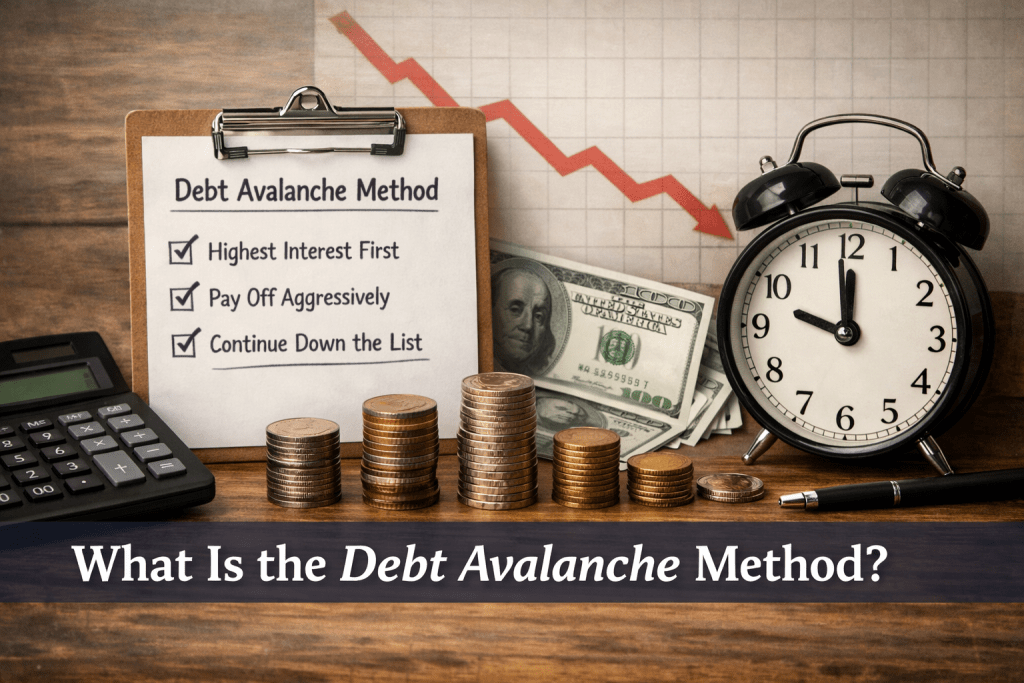
The Debt Avalanche Method is a debt repayment strategy where you prioritize paying off debts in order of highest interest rate first, regardless of the balance size. You make minimum payments on all your debts, then channel any extra money toward the debt with the highest APR (Annual Percentage Rate).
Once the highest-interest debt is paid off, you roll that entire payment amount into the next-highest interest rate debt — creating a compounding payoff effect (the “avalanche”) that accelerates over time.
This method is championed by personal finance experts and mathematicians alike because it is the most cost-effective way to repay multiple debts. You minimize the total interest you pay over the life of your debt, which means more of your hard-earned money stays in your pocket.
Why the Avalanche Method Saves You the Most Money
To understand why the Avalanche Method is so powerful, you need to understand how compound interest works against you.
When you carry a balance on a credit card with a 28% APR, that interest compounds monthly. If you have a $5,000 balance and only make minimum payments, you could end up paying over $3,000 in interest alone before the balance is cleared — and it could take over five years to do it.
The Avalanche Method targets these high-interest accounts first, stopping that compounding cycle at its most damaging point. By eliminating your 28% APR card before your 18% APR card, you literally cut off the most expensive interest accumulation first.
The Interest Savings Are Real
|
If you want to explore all the options available for getting out of debt, our comprehensive guide on debt relief strategies covers multiple approaches to help you choose the right path for your situation.
How to Use the Debt Avalanche Method: Step-by-Step
Step 1: List Every Credit Card Debt You Have
Start by creating a complete inventory of all your credit card debts. For each card, write down:
- The current outstanding balance
- The interest rate (APR)
- The minimum monthly payment required
- The name or type of card
Do not leave any debt off this list. Hidden or forgotten balances will continue accumulating interest regardless of whether you acknowledge them. Use your most recent statements or log into each card’s online portal for accurate figures.
Step 2: Sort Your Debts by Interest Rate (Highest to Lowest)
Once you have your complete list, sort the debts from highest APR to lowest APR. This ranking is your Avalanche Order — the exact sequence in which you will attack each debt.
Here is an example of how this looks in practice:
| Card | Balance | APR | Avalanche Priority |
| Card A (Retail) | $3,200 | 28.99% APR | 🥇 Pay off FIRST |
| Card B (Travel) | $7,800 | 22.49% APR | 🥈 Pay off SECOND |
| Card C (Personal) | $1,500 | 17.99% APR | 🥉 Pay off THIRD |
In this example, Card A (28.99% APR) gets the avalanche attack first, even though Card C has a smaller balance. The math demands it — Card A is costing you the most money every single month.
Step 3: Set a Monthly Debt Repayment Budget
Calculate exactly how much money you can allocate to debt repayment each month. This should be a fixed, non-negotiable number — treat it like a bill you must pay.
Your repayment budget = (sum of all minimum payments) + (any extra money available)
Even an additional $50 or $100 per month over minimums can dramatically cut your payoff timeline. If you need help identifying areas to cut spending, our guide on avoiding debt with expert personal finance tips offers practical strategies.
Step 4: Make Minimum Payments on Everything Except the Top Priority
Every month, pay the minimum required payment on all your credit cards. This keeps your accounts in good standing, protects your credit score, and avoids late fees and penalty APRs.
Do not skip minimums on lower-priority debts in an attempt to send more money to your top card — this will backfire through fees and credit score damage.
Step 5: Throw Every Extra Dollar at the Highest-Interest Debt
After paying all minimums, direct your entire remaining repayment budget to the card with the highest APR — Card A in our example. This is the accelerant that makes the avalanche work.
Every dollar above the minimum that you apply to Card A is a dollar that stops accumulating 28.99% interest. Month after month, this adds up to enormous savings.
Step 6: Roll Payments Down to the Next Debt When One Is Paid Off
When Card A is fully paid off, take the entire amount you were paying to Card A each month (minimum + extra) and add it to what you’re already paying on Card B.
This is the “roll” — and it’s what creates the avalanche effect. Your payment toward Card B essentially doubles or triples overnight. Card B gets paid off faster, and then you roll that entire combined amount into Card C. The momentum builds with each payoff.
📌 The Avalanche Roll in Action:
|
A Real-World Avalanche Method Example
Let’s put real numbers to the three cards in our table above and see exactly what the Avalanche Method saves you.
Your Debt Situation:
|
Using the Avalanche Method, the extra $300/month goes straight to Card A each month. Card A gets $364/month while B and C get minimums.
Result: Card A is paid off in approximately 10–11 months. Then the full $364 is added to Card B’s payment. Card B gets approximately $520/month and is cleared in roughly another 16–18 months. Finally, Card C gets the full $550/month and is gone in just a few more months.
Total estimated time to become credit card debt-free: approximately 30–33 months.
Estimated total interest paid with the Avalanche Method: approximately $2,800–$3,200.
Compare this to paying only minimums — where you could pay over $11,000 in interest and take more than 15 years to become debt-free. The Avalanche Method saves you roughly $8,000 and over a decade of your life.
Debt Avalanche vs. Debt Snowball: Which Is Better?
The Debt Snowball Method — popularized by financial commentator Dave Ramsey — works differently. With the Snowball, you pay off your smallest balance first, regardless of interest rate. The psychological wins of clearing small debts are meant to motivate you to keep going.
| Factor | Avalanche Method | Snowball Method |
| Priority Order | Highest interest rate first | Lowest balance first |
| Interest Savings | ✅ Maximum savings | ⚠️ More interest paid |
| Speed to Debt Freedom | ✅ Fastest mathematically | ⚠️ Slightly slower |
| Motivation Factor | ⚠️ Slower early wins | ✅ Quick psychological wins |
| Best For | Math-motivated, patient planners | People needing motivation boosts |
| Recommended If | You have high-APR cards | Smallest debt feels overwhelming |
The bottom line: if your primary goal is to pay the least amount of interest and become debt-free as quickly as possible, the Avalanche Method wins every time. If you struggle with motivation and need quick wins to stay committed, the Snowball can be a valid psychological tool — just know it costs more in the long run.
5 Ways to Accelerate Your Avalanche Payoff
The Avalanche Method works even better when combined with strategies that free up more cash to throw at your debts.
1. Use a Debt Consolidation Loan
If you qualify, a personal debt consolidation loan at a lower interest rate than your credit cards can simplify your repayment and reduce the total interest you owe. Our detailed guide on how to use debt consolidation loans properly walks you through how to evaluate whether this is right for you.
2. Request a Lower APR from Your Card Issuer
Many people don’t realize that you can simply call your credit card company and request a lower interest rate. If you have a history of on-time payments, they may reduce your APR — sometimes by several percentage points. This directly accelerates the Avalanche Method.
3. Use Windfalls Strategically
Tax refunds, work bonuses, cash gifts, or side income should go directly toward your highest-APR balance. A single $1,500 tax refund applied to Card A in our example could shorten your payoff by two or three months.
4. Temporarily Cut Non-Essential Expenses
Identify one or two discretionary spending categories — dining out, subscriptions, entertainment — and temporarily redirect that budget to debt repayment. Even an extra $75–$150/month makes a meaningful difference when applied to high-interest debt.
5. Automate Your Payments
Set up automatic payments for the minimum on every card, then schedule a recurring transfer to your top-priority card. Automation removes the temptation to spend that money elsewhere and ensures you never miss a payment.
Common Mistakes to Avoid When Using the Avalanche Method
- Skipping minimum payments on lower-priority cards — This triggers late fees, penalty APRs, and credit score damage that will set you back.
- Continuing to add new charges to your cards — You cannot avalanche a debt that keeps growing. Freeze or lock cards if needed.
- Giving up after a slow start — The Avalanche Method takes longer to show early wins than the Snowball. The payoff comes later but is far greater.
- Not updating your list as balances change — Review your debt list monthly and adjust if interest rates change (especially on variable-rate cards).
- Neglecting an emergency fund — Without a small cash buffer ($500–$1,000), an unexpected expense forces you onto a credit card and undoes your progress.
Tools to Help You Track Your Avalanche Progress
You don’t need to manage this entirely in your head or on paper. Several free and paid tools can help:
- Spreadsheets (Google Sheets or Excel) — Build a simple tracker with your debts, balances, APRs, and monthly payments. Update it monthly.
- Budgeting Apps — Apps like YNAB, Monarch Money, or Mint can link directly to your accounts, track balances automatically, and alert you to payment due dates.
- Debt Payoff Calculators — Dozens of free online calculators let you input your exact balances and APRs to visualize your payoff timeline under the Avalanche Method.
When the Avalanche Method Might Not Be Enough
The Avalanche Method is powerful, but it assumes you have enough income to cover minimums plus extra. If your debt has become overwhelming — if you’re missing payments, receiving collection calls, or considering bankruptcy — there are additional options to explore.
Debt settlement, for instance, involves negotiating with creditors to pay less than the full balance. Our guide on what you need to know about debt settlement explains the process, risks, and potential benefits.
If you’re in a more serious financial crisis, it may also be worth exploring whether bankruptcy protection is appropriate for your situation. Read our guide on should you file for bankruptcy to understand the signs and what the process entails.
For help choosing the right debt relief company if you decide to seek professional guidance, our breakdown of choosing a reputable debt relief company is a must-read.
Frequently Asked Questions (FAQ)
Is the Avalanche Method better than the Snowball Method?
Mathematically, yes. The Avalanche Method minimizes the total interest you pay and gets you out of debt faster. However, the Snowball Method can be more effective for people who need psychological wins to stay motivated. The best method is the one you’ll actually stick with.
How long does the Avalanche Method take?
It depends entirely on your total debt, interest rates, and how much extra you can pay each month. With consistent effort and a meaningful extra payment, most people can eliminate credit card debt within 2–5 years using the Avalanche Method.
Can I use the Avalanche Method with student loans or a mortgage?
Yes. While this guide focuses on credit card debt, the Avalanche Method applies to any combination of debts — student loans, personal loans, auto loans, and even mortgages. Simply rank them by APR and apply the same process.
What if two debts have the same interest rate?
If two debts have identical APRs, prioritize the one with the smaller balance. This way you eliminate one account faster, simplifying your finances and reducing minimum payment obligations sooner.
Should I stop using my credit cards while using the Avalanche Method?
Yes, ideally. Continuing to charge new purchases to cards you’re trying to pay off undermines all your progress. Use cash or a debit card for day-to-day spending until your cards are paid off.
Related Articles
Continue your debt education with these hand-picked resources:
- The Debt Snowball Method – How Do You Make It Work For You?
- How to Use Debt Consolidation Loans Properly
- Key Tips to Experience Debt Relief Fast
- Awesome Tips to Protect Yourself from Debt
- Avoid Debt With These Expert Personal Finance Tips
- What All To Know About Debt Settlement
- Should You File for Bankruptcy? Signs It Might Be Time
- Choosing a Reputable Debt Relief Company
- How to Use Short-term Lending Responsibly
- All Debt Articles on Finance Care Guide